Parcel · LTL · TL · FTL — for SAP, Oracle, Dynamics, Infor & NetSuite

Multi-carrier shipping software that runs inside your ERP, not beside it.

Your team rate-shops, prints compliant labels, files export docs and tracks delivery from the order screen they already use. No second console. No swivel-chair data entry. No middleware for IT to babysit.

  • Rate-shop every carrier on every order automatically
  • DG/hazmat, denied-party and export filing built in
  • Labels and commercial invoices straight from the ERP record

Native integrations

SAP S/4HANASAP EWMOracle FusionDynamics 365Infor M3NetSuiteSageBlue YonderManhattan

See it run on your ERP

Thirty minutes, your stack on screen, questions answered by someone who has implemented it. Bring your hardest shipping rule.

No cost, no obligation. A US-based solutions engineer replies within one business day to pick a time.

This is what happens to one order

A delivery gets created in your ERP. ShipperCopilot rate-shops it against your own negotiated carrier contracts, applies your shipping rules, and writes the choice back — before anyone touches a keyboard.

Rule applied: cheapest service that still meets the customer promise date. Label, packing list and manifest written back to the delivery record. Elapsed time: under a second.

Delivery 8000241173 · SAP S/4HANA

3 CTN · 41.2 LB · ZIP 30349 → 60642 · Residential
  • UPS Ground2-day transit
    $18.42meets promise dateSelected
  • FedEx Home Delivery2-day transit
    $19.87meets promise date
  • USPS Ground Advantage4-day transit
    $16.05misses promise date
  • OnTrac3-day transit
    $17.60no service to ZIP

The problem underneath

Shipping money rarely leaks in one big place

It leaks a few dollars at a time, on thousands of orders, in the gap between your ERP and your carriers' portals.

Leak 01

Manual carrier choice

When a rep picks the carrier from memory or habit, the cheapest compliant service wins only some of the time. Nobody notices, because nobody is comparing.

Leak 02

Re-keyed shipment data

Address, weight and dims typed a second time into a carrier portal means correction fees, reweighs and returns that trace back to a typo, not a carrier.

Leak 03

Compliance handled off-system

DG paperwork, denied-party screening and export filings done on memory or a spreadsheet are fine until the one shipment that gets held, fined, or turned back.

How it fits

Three things change. Your team's screen isn't one of them.

Step one

We connect to your ERP

ShipperCopilot reads deliveries and writes shipping data back through a certified integration to SAP, Oracle, Dynamics, Infor or NetSuite. Your master data stays where it is.

Step two

We encode your shipping rules

Promise dates, customer routing guides, hazmat handling, account splits, service restrictions. The rules your senior people carry in their heads become the ones the system runs.

Step three

Your floor keeps working as-is

Pack, scan, print. The label, the paperwork and the tracking are already correct because the decision was made upstream from the ERP record, not downstream from a portal.

ERP to ShipperCopilot to carriers workflow

Certified ERP connection

Your master data stays where it is

ShipperCopilot reads deliveries and writes the label, packing list, tracking and manifest back through a certified integration. The warehouse keeps packing, scanning and printing the way it already does.

What's in the box

One engine from quote to proof of delivery

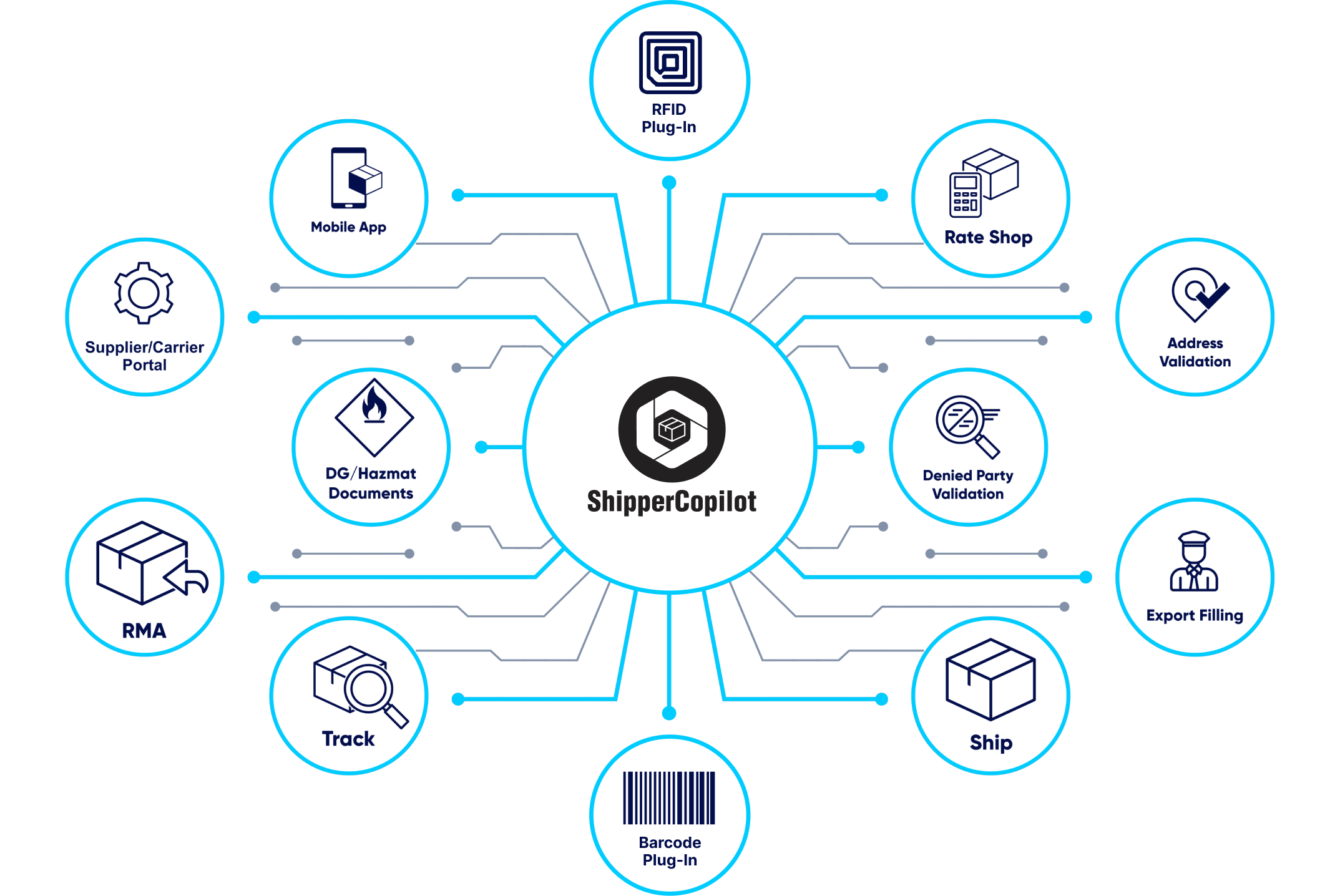
Rate shopping

Every carrier and service compared per shipment against your own contracted rates, filtered by your rules.

Labels & documentation

Carrier-compliant labels, packing lists, BOLs and commercial invoices generated from the ERP record.

Address validation

Addresses standardised and verified before the label prints, so correction fees stop appearing on the invoice.

DG & hazmat

Dangerous-goods documentation and handling rules applied automatically to the shipments that need them.

Denied party & export filing

Destination screening and export documentation prepared as part of the shipment, not after it.

Returns & tracking

Rule-based RMA with pre-approved labels, plus end-to-end tracking across every carrier in one view.

Why enterprises switch

The parts a shipping console can't reach

Most multi-carrier tools stop at rate and label. If you ship regulated goods, cross-border, or against retailer routing guides, that's where the real work starts — and where a separate system starts costing you.

Regulated shipments

DG/hazmat documents generated against the shipment's actual contents and destination.

Cross-border

Export filing and commercial invoices prepared from ERP data, so customs doesn't hold the pallet.

Retailer compliance

Routing guide rules, compliant labels and BOLs applied per customer account.

Inbound

Supplier and carrier portals so your vendors book against your rules, not theirs.

See it on your stack

Certified integrations for the ERPs operations teams already run

SAP S/4HANA Cloud integration with ShipperCopilotSAP S/4HANA Cloud
Oracle Fusion Cloud integration with ShipperCopilotOracle Fusion Cloud
Microsoft Dynamics 365 integration with ShipperCopilotMicrosoft Dynamics 365
Oracle NetSuite integration with ShipperCopilotOracle NetSuite
Infor M3 integration with ShipperCopilotInfor M3
Sage X3 integration with ShipperCopilotSage X3

Proof

Operations teams already running on it

Enterprise buyers want evidence, not a slide deck. On the demo we walk through a live rate shop on your ERP, your carriers, and the shipping rules that currently live in people's heads.

  • Certified connectors for SAP, Oracle, Dynamics, Infor and NetSuite
  • Your negotiated carrier rates — we do not resell shipping
  • Parcel, LTL, TL and FTL from the same engine
  • A US-based engineer on the first call, not a qualifier

Certifications

UK certificationISO certification

Honest comparison

Three ways enterprises solve this

Worth knowing which one you're actually choosing between.

ShipperCopilotStandalone shipping consoleCarrier-provided tools
Where your team worksInside the ERP order screenA second application, keyed separatelyOne portal per carrier
Rate shopping across carriersAutomatic, rules-drivenAvailable, usually manual setupNot possible — single carrier
Your negotiated carrier ratesYours, used directlySometimes replaced by the vendor's ratesYours, per carrier
DG, denied party, export filingBuilt inOften an add-on or out of scopeYour responsibility
Freight modesParcel, LTL, TL, FTLUsually parcel-firstWhatever that carrier sells
Where shipping data ends upBack in the ERP recordIn the console, synced laterIn a portal, exported manually

Before you book

The questions buyers actually ask first

It depends on how many ERP entities, carriers and rule sets are in scope. On the demo call we walk through your specific setup and give you an honest range with the assumptions written down, so you can compare it against other quotes on the same basis.

See ShipperCopilot on your own ERP

Thirty minutes, your stack on screen, questions answered by someone who has implemented it. Bring your hardest shipping rule.

or call 1-888-464-2360 · sales@eshipjet.ai · Plano, TX